
Survivorship Bias, for Marketers
Classics look inevitable in hindsight. Before they were hits, they were risky like everything else that shot for the moon. As newer generations become the go-getters and doers of our teams, it might be worth taking a spin through the YouTube archive to see Apple’s positioning and Microsoft’s counter to the radical shift in the market during the iPhone launch.
In 2007, Apple took a calculated risk: the iPhone’s capacitive-touch UI and $500 launch price, wrapped in a friendly, familiar design, were somewhat disruptive and radical. Microsoft’s CEO, Steve Ballmer, publicly dismissed it. With no physical keyboard and mile high price, it wouldn’t be a serious email machine for businesses and professional users.
Microsoft was satisfied with its OEM strategy. Apple’s choice predictably repelled the keyboard-first purists.
However, the iPhone became a paradigm-shifting success; three years later, Microsoft answered back with the live tile Windows Phone. It was bold in places but late, perceived as derivative, and undercooked.
The lesson here is that risk only buys you a seat at the table, not a guaranteed return.
Teams producing exceptional creative rarely know it’s exceptional while they’re in it. And we understand that bold isn’t new; it’s the ideal path for creatives to follow. What throttles it now is red tape, create-by-committee, and de-risking every approval up the chain.
Perhaps the onus is on us, the creatives. We used to be better at explaining why good creative works—logic, proof, and plan.
Luck and timing are real. As the apocryphal Napoleon line goes, better a lucky general than merely a good one. You can’t control luck, but you can factor it into your approach. You can increase the surface area of success and maximize luck’s output by choosing the bold path over the bland one.
There’s No Guarantee for Success, but You Can Increase Your Chances
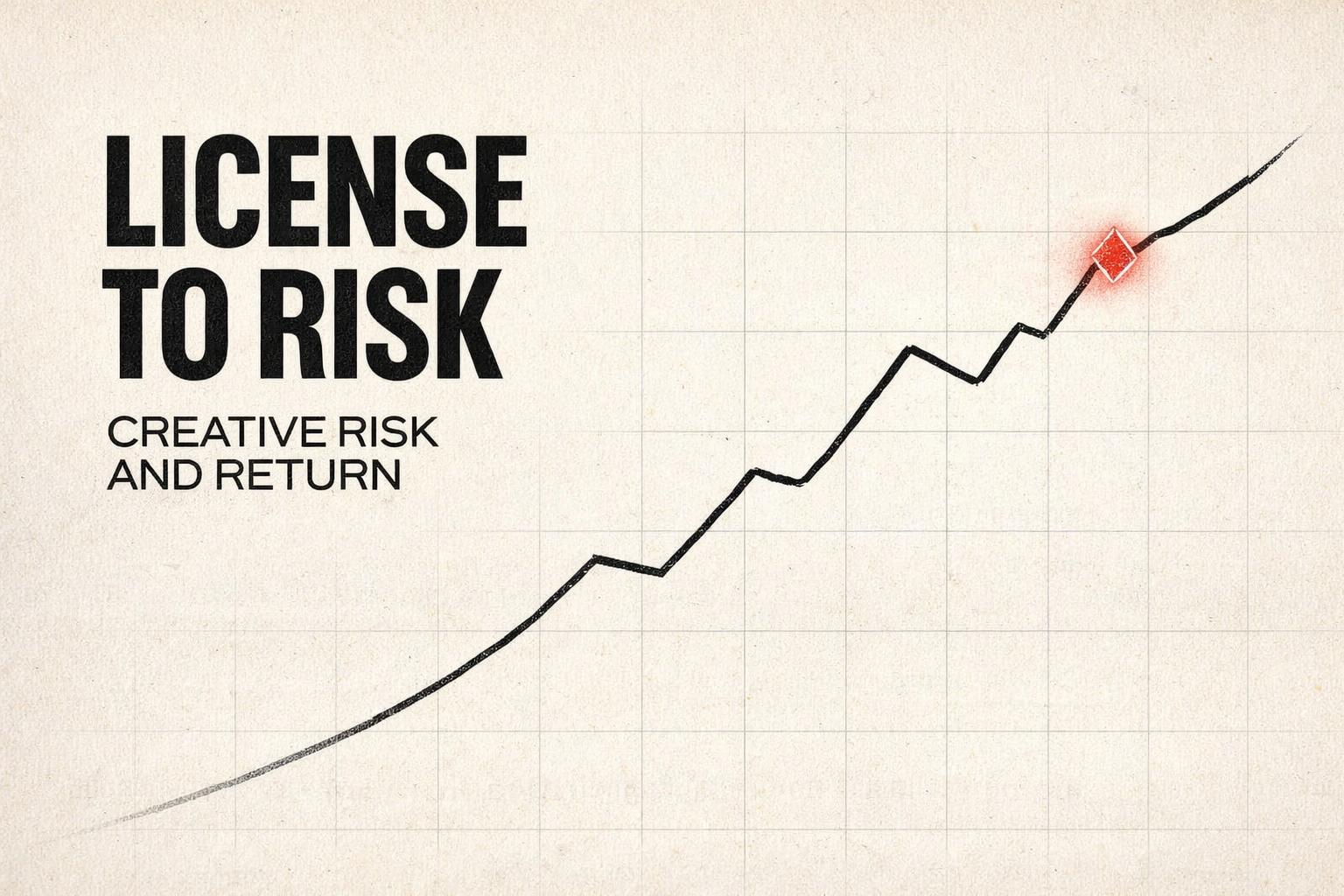
There isn’t exactly a recipe for breakout work, but there is a curve. Low-risk creative has capped returns. I’ve found that taste-forward, asymmetric bets on your creative compound the potential for higher returns when you learn from them. So, build your creative or content operating model around that curve.
Those sharp or edgy narratives can become force multipliers for your content, creative, product marketing, or any other team(s) that help place the building blocks of your story where it meets your audience.
If nobody asks, “Are we sure we want to say that?”, your message probably isn’t worth saying.
Strong messages, like strong products, can’t be everything for everybody. Treat your creative operations like a portfolio, with different buckets for levels of risk or edginess, and assign each body of work a risk budget. Keep your publication/production tempo in mind, and distribute your weights accordingly.
Defining the Curve: Risk vs. Return
If we’re taking a truly operational approach to how a team produces messaging and narratives, precise, repeatable definitions and variables need to be established. That way, any strategy that’s put in place can actually scale beyond a single tastemaker—a single copywriter, product marketer, etc.
Risk (a.k.a. Boldness or Edginess) Indicators
Novelty of the premise. Is the idea genuinely new in your category? Is your unique spin actually functionally different?
Sharpness of POV. Is the point of view you’re using to illustrate your case specific and narrow enough? Is it defensible? Here’s where you might run into pushback from a consensus committee. Narrow and specific will resonate strongly with the intended audience but won’t fit with those outside that target.
Intended repulsion. The downside of being narrow and specific is that your message will lie flat (at best) and go unnoticed by others. Include this in your strategy, decide and define whom you’re willing to repel; non ICP segments, status-quo defenders, etc.)
Downsides exist. If your pitch implies no downsides, then it’s a fairy tale. It’s not a pitch. Selling (and marketing) boils down to persuasive arguments. There is something you’re trying to get your audience not to choose. Know what it is.
Return Indicators (Not a Guarantee, but Directional)
Distinctiveness. Is your narrative memorable? Does it keep the excitement you hold within the translation? If a stranger were to retell it, would it click with an audience? Would that excitement pass on to the stranger, and then that stranger's audience? What you’re shooting for here is for your message to be contagious.
Voice. This is somewhat difficult for medium-sized to larger organizations. It’s still an issue for the smallest one-person marketing departments, too, but those scenarios tend to have fewer gates to keep. Is your voice consistent across time? Is your voice specific (recognizable as a style/tone)? Is it unmistakably yours? Use examples of your neighboring brands from your swipe file. Recreate their look/feel and swap in your headline with their brand colors to create a virtual mugshot lineup. Can you (or a stranger) pick yours out from the list?
Qualified resonance. Once your work is out in the wild, track its performance. You’re looking for higher open, read, and reply rates. Or on the social end, things like shares and saves.
Commercial signals. Simply attribution to pipeline, revenue, pricing power, and velocity. You can track individual pieces and channels. I also prefer to collect individual data from all pieces and channels into a unified campaign based on a single concept/idea/narrative.
This gives you a better real-world feel for the return, which you can provide to your sellers as a recommendation to use the same talk track and narrative once they take the baton. Remember: business is a team sport.
“Make it viral” is clumsy wording for a reasonable ask: shape the message to earn outsized spread. High potential upside lives where risk isn’t zero.
Plotting on these axes won’t guarantee a hit, but it’ll move you into the right ballpark for those home runs to occur, and your strategy is to do this on purpose.
The Cost of Being Safe
“Safe” gets thrown around like shorthand, especially by us marketers, and usually in a derogatory sense. For this argument, let’s define safe as aiming for the mean average of copy and creative. Imagining ranking adjacent work, from worst to best, and shooting for the middle.
That’s not neutrality (which may be an ideal position for your brand voice), it’s artificially average. Audiences will smell hedging. Content that’s pruned of anything sharp becomes invisible. And invisible content never gets a chance to return on anything.
The point here is that you can model risk vs. return, which might illuminate to you and your team(s) why most B2B content lives in the low-risk/low-return corner.
What If You Had a Creative Risk Budget?
Create a budget plan for your creative risk, just as you’d do with everything else. Here’s an example of what that might look like based on all of the variables we’ve gone over:
Example allocation (tune to taste):
70% Proven & Broad: reliable formats, brand-safe claims, middle-of-the-road POVs that map across various target audiences.
20% Edge Tests: new angles, bolder language, novel distribution. Protect these from the revision cycles that might dilute the voice.
10% Wild Cards: contrarian positions, narrative flips, and left field concepts no competitor would ship.
When presenting the riskier positions to stakeholders, get specific and define stops, pivots, and the double-down criteria for each tier. Guide and isolate any debate to the claim, not to the presence of risk or edge within the creative.
Taste as a Force Multiplier
Taste is subjective, and currently, the latest buzzword in the content marketing world. Subjectivity is a good thing, but it’s our job to make it measurably subjective.
Build a swipe file of what good looks like: your brand, neighbors, even other industries. Keep the size of your file finite on purpose; adding a new example should force a debate about which one(s) to remove. Revisit the entire thing quarterly or between major campaigns.
Remember to use your internal definition and taste parameters. Your swipe file shouldn’t be an example of industry average; it should be a curated collection of bold hooks and radical compositions you believe you can get away with (and some you won’t get away with). The job of your swipe file is to pull you and your team’s work toward those pillars.
A short, reality-based POV increases the right signals. If your hook calls out a specific job title or use case, broad engagement might dip, but response from actual targets will over-index. That is the basic premise.
Over-index with the right people and under-index with the rest. The alternative is creative mediocrity.
This framing makes boldness legible to stakeholders. It’s not “be edgy for art’s sake”, but rather a calculated framework to position more potential wins. This is fundamentally what your demand gen and paid media teams already do, so the process is recognizable. But your creative, including your core narratives and messaging, needs to adopt that same philosophy.
Stakeholders naturally prefer “safe” because it looks familiar, uses the right buzzwords, and sits near the market's average level of sharpness or creative risk. Stakeholders also need to understand that a full plan and strategy are in place; if you define the risks, set guardrails, and outline expected outcomes up front, you’re showing that strategy…not just taste. And that’s easier to win approval.
Figure Out Your Abrasion Threshold
Great campaigns are wrong for someone on purpose.
If your goal is persuasion, your argument stands in opposition to an alternative you want the audience to reject. The more you sharpen your narrative, the more people it will not serve. That’s abrasion, and it’s a feature, not a bug.
Calibrate who you’re willing to repel: non-ICP segments, low-intent browsers, legacy-stack loyalists, or the defenders of the status quo. You know that those personas are already the hardest people to win… but instead of keeping it in the back of your mind, plan to document it.
Make a list of the personas you’re avoiding to target, throw it on your whiteboards and in your briefs, and act like it’s a checklist. Plan to avoid catering to them in your narrative. In the world of paid media, this is table stakes. Why spend to reach segments you don’t want, and who won’t be moved? Apply the same selectivity to creative, hooks, and headlines.
Your friends in demand gen will appreciate it, because it’ll mean low-performing ads won’t be fully their responsibility. There will be an empirical set of variables to apply to the creative to improve its performance.
Don’t engineer precision targeting with your paid media to serve it damp messaging.
Set guardrails: red lines (don’t cross), green lines (tones/topics that are fair game), and acceptable levels of contrarianism. Establish a rubric to measure principled pushback like volume, frequency, and quality. Haters are data too.
With this scientific approach to planning, executing, and recording performance, it’s easier to gain stakeholder approval for riskier creative work.
Learn in Public
Shorten feedback cycles. Turn any one-off internal approval procedure into a regular cadence. Shift the roles of your typical collaborative approvers into advisers.
Set the goal of review sessions explicitly: avoid the “make it broader”, “tone it down”, and “add for everyone” types of critique and feedback. Those generalities are anti-goals in this mode. Rather, score your critique against your risk signals. Report the results. Establish where those edgy ideas travel well (owned, earned, social, partners, PR, etc.) and tune your distribution accordingly.
To see a real delta, you need a healthy baseline of those 70% pieces.
Quick Notes to Remember for Creatives
Audiences detect hedged copy. Your ideal personas can and will tell when hooks were boiled down in stakeholder committees.
Your internal buzzwords don’t travel. Outside your walls, nomenclatures and taxonomies don’t matter. The same goes for apology clauses; replace them with specific claims, evidence, and strong verbs. Escalate certainty, but only where proof exists.
Curate your swipe file. It’s a library of judgment, not a clip-art bin. Make your choices based on fit, not volume. Annotate with the why, include the edge level, structure, proof moves, and so on… not just screenshots.
One-sheet memo: Adopt the P&G style memo. Short leads, earned claims, and one big idea per sheet. It’d do well to add a pass/fail gate as well: before we publish, what’s the single most emotional truth we want them to feel?
No organization thrives on unanimous approval. Businesses, like your customers, are run by people speaking to other people. Creatives, and maybe marketers in general, have a license to risk.
The onus is on us to partner across the org, plan with measurable goals, and raise our craft with evidence-based boldness. Calibrate your distribution, but remember that wasting a shot with weak messaging erases the opportunity just the same.
Establish regular cadences with your collaborative stakeholders so each new project isn’t a trial balloon. Approval, feedback, and advice should be a continuous discovery loop where you’re tracking the leading indicators that precede deal impact so any narrative lift ties to sales outcomes.
You can’t guarantee lightning. But you can absolutely walk onto the hill with a very tall metal pole, on purpose.
